Inspiration | YogX
The Divine Source: Akaal Purakh
“एको देवः सर्वभूतेषु गूढः सर्वव्यापी सर्वभूतान्तरात्मा।”
(The One Divine is hidden in all beings, all-pervading, the inner Self of all.)
— Śvetāśvatara Upaniṣad (6.11)
YogX draws its inspiration from the Formless Divine—Akaal Purakh, the eternal, boundless power beyond time and space. This supreme consciousness is also revered as Sadashiva, the primordial force of creation, preservation, and dissolution. In His Nirakaar (formless) state, He is the silent witness; in Sakaar (form), He manifests as the cosmic dancer (Nataraja), the meditating ascetic (Mahayogi), and the compassionate protector (Shankara).
From His infinite energy emerged Adi Shakti, the divine feminine power—the dynamic force that breathes life into existence. Together, they represent the perfect balance of consciousness (Shiva) and energy (Shakti). This cosmic duality is recognized across world traditions as:
The Sacred Journey with the Guru
“गुरुर्ब्रह्मा गुरुर्विष्णुः गुरुर्देवो महेश्वरः।
गुरुः साक्षात् परं ब्रह्म तस्मै श्री गुरवे नमः॥”
(The Guru is Brahma, the Guru is Vishnu, the Guru is Maheshwara (Shiva).
The Guru is the Supreme Brahman itself; to that glorious Guru, I bow.)
— Guru Gītā
The Meaning of Guru
The word “Guru” transcends its literal meaning of a teacher. It is derived from “Gu” (darkness) and “Ru” (light)—the one who dispels ignorance and leads the seeker to self-realization (Atma-Jnana).
Guru as a Teacher
Formal Guru: Guides in structured knowledge (Vedas, scriptures, arts, sciences).
Informal Guru: Life itself, experiences, and mentors who shape wisdom.
The True Spiritual Guru
A divine Guru is not just a human guide but a channel of divine wisdom. Such a Guru:
Is free from ego and personal desires.
Embodies truth (Satya), compassion (Karuna), and detachment (Vairagya).
Leads the disciple from darkness (Avidya) to light (Jnana).
At YogX, we recognize Sadashiva as the Adi Guru (First Teacher)—the source of all yogic wisdom. While great sages like Patanjali systematized yoga, its origin lies in Sadashiva Himself, the Adiyogi (First Yogi) who imparted the science of yoga to the Saptarishis (Seven Sages).
The Divine Feminine Power: Adi Shakti
The Roots from Ancient Text
“या देवी सर्वभूतेषु शक्तिरूपेण संस्थिता।
नमस्तस्यै नमस्तस्यै नमस्तस्यै नमो नमः॥”
(To the Goddess who resides in all beings as energy,
Salutations to Her, again and again, I bow!)
— Devī Sūktam (Ṛgveda 10.125.3)
Just as the Guru is essential, so is the Mother—the nurturing, loving, and protective force. In the form of Ardhanarishvara, Shiva and Shakti are one, yet the feminine energy (Adi Shakti) is the first teacher—the one who loves, cares, and shapes existence.
Forms of Adi Shakti
Parvati (The Gentle Nurturer, consort of Shiva)
Durga (The Warrior who destroys evil)
Kali (The Fierce Liberator from ego)
Lakshmi (The Bestower of abundance and grace)
Saraswati (The Goddess of wisdom and arts)
She is the Prakriti (Nature) that sustains life, the Kundalini (Divine Serpent Power) within us, and the Divine Mother who guides the soul home.
Sacred Avatars
Adashiva Avatar
Lord Shiva – The Cosmic Yogi
“न तस्य प्रतिमा अस्ति यस्य नाम महद्यशः।”
(He has no equal, whose name is greatness itself.)
— Yajurveda (32.3)
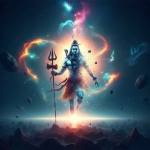
As Mahadeva (Great God): The supreme ascetic, absorbed in meditation, yet compassionate to devotees.
As Nataraja: The cosmic dancer who performs the Tandava, the dance of creation and destruction.
As Neelkantha: The one who drank the poison (Halahala) to save the universe.
As Bhairava: The fierce protector who annihilates ignorance.
Shiva is Bholenath (The Innocent One), Rudra (The Howling Storm), and Shankara (The Benevolent)—all in one.
Adishakti Avatar
Chamunda – The Fierce Protector
“चामुण्डे जगदम्बे देवि नारायणि नमोऽस्तु ते।” (O Chamunda, Mother of the Universe, Narayani, I bow to Thee!) — Chamunda Kavacham
-
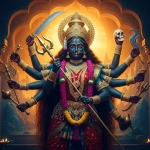
A fierce form of Adi Shakti, she is Kali Ma’s warrior aspect, who slays demons Chanda & Munda.
-
Symbolism:
-
Cremation Grounds: Represents detachment from illusion (Maya).
-
Skull Garland (Mundamala): Signifies the cycle of life and death.
-
Scimitar & Trishul: Cuts through ego and ignorance.
-
She is Chamunda Devi, the Kuldevi (Clan Goddess) who protects devotees from negativity and grants spiritual fearlessness (Abhaya).
Universal Names of the Divine Duality
Sanatana Dharma
Concept: Ardhanarishvara (Shiva-Shakti)
Sacred Text Reference:
“स्त्रीरूपं च पुमान् रूपं चैक्यं भैरवभैरवी”
(The feminine form and masculine form are united as one in Bhairava-Bhairavi)
— Rudrayamala Tantra
Explanation:
Shiva (Masculine): Pure consciousness, stillness, transcendence
Shakti (Feminine): Creative energy, dynamic power, manifestation
The Ardhanarishvara form symbolizes perfect balance – half male (Shiva) and half female (Parvati).
Buddhism (Vajrayana)
Concept: Upaya (Skillful Means) & Prajna (Wisdom)
Sacred Text Reference:
“प्रज्ञोपायमयः कायः सर्वबुद्धः प्रकाशते”
(The body of all Buddhas consists of wisdom and skillful means)
— Hevajra Tantra 1.1.12
Explanation:
Upaya (Masculine): Compassionate action, method
Prajna (Feminine): Transcendent wisdom, emptiness
Their union represents enlightenment, as stated in the Guhyasamaja Tantra: “Wisdom and method united bring Buddhahood.”
Jainism
Concept: Purusha (Consciousness) & Prakriti (Matter)
Sacred Text Reference:
“पुरुषः प्रकृतिर्योगाद्भवति सर्वं जगत्”
(From the union of Purusha and Prakriti emerges the entire universe)
— Dravyasamgraha 2
Explanation:
Purusha (Masculine): Pure sentience, the Jiva (soul)
Prakriti (Feminine): Material substance, that which binds the soul
Sikhism
Concept: Nirgun (Formless) & Sargun (Manifest)
Sacred Text Reference:
“निर्गुण सरगुण दोनों धारी”
(The One who pervades both formless and manifest forms)
— Guru Granth Sahib, Ang 287
Explanation:
Nirgun (Masculine): Transcendent, attributeless Divine
Sargun (Feminine): Immanent, personal God in creation
Taoism (China)
Concept: Yin-Yang
Sacred Text Reference:
“道生一,一生二,二生三,三生万物”
(The Tao gives birth to One, One gives birth to Two, Two gives birth to Three, Three gives birth to all things)
— Tao Te Ching, Chapter 42
Explanation:
Yang (Masculine): Active, bright, heavenly
Yin (Feminine): Receptive, dark, earthly
Judaism (Kabbalah)
Concept: Tiferet (Harmony) & Shekhinah (Divine Presence)
Sacred Text Reference:
“כבוד ה’ מלא את המשכן”
(The glory of Yahweh filled the tabernacle [Shekhinah])
— Exodus 40:35
Explanation:
Tiferet (Masculine): Divine harmony and beauty
Shekhinah (Feminine): Immanent Divine presence
Christian Mysticism
Concept: Christ (Logos) & Sophia (Divine Wisdom)
Sacred Text Reference:
“Ἐγὼ εἰμι ἡ ὁδὸς καὶ ἡ ἀλήθεια καὶ ἡ ζωή”
(I am the way, the truth, and the life [Logos])
— John 14:6
“σοφία δὲ ἐδικαιώσατο ἀπὸ τῶν ἔργων αὐτῆς”
(Wisdom is justified by her works)
— Matthew 11:19
Explanation:
Logos (Masculine): Divine Word, ordering principle
Sophia (Feminine): Holy Wisdom, creative intelligence
Islam (Sufism)
Concept: Nur (Divine Light) & Dhikr (Remembrance)
Sacred Text Reference:
“الله نور السماوات والأرض”
(Allah is the Light of the heavens and the earth)
— Quran 24:35
“فاذكروني أذكركم”
(Remember Me, I will remember you)
— Quran 2:152
Explanation:
Nur (Masculine): Divine illumination
Dhikr (Feminine): Devotional remembrance
Zoroastrianism
Concept: Ahura Mazda (Wise Lord) & Spenta Armaiti (Divine Devotion)
Sacred Text Reference:
“अशा वहिष्टा स्पेन्ता अरमैती”
(Through Asha, Spenta Armaiti flourishes)
— Yasna 47.1
Explanation:
Ahura Mazda (Masculine): Supreme wisdom
Spenta Armaiti (Feminine): Earthly devotion
Ancient Egyptian
Concept: Osiris (Order) & Isis (Creation)
Sacred Text Reference:
“I am Isis, the mistress of every land”
— Pyramid Texts, Utterance 365
“Osiris the triumphant, justified forever”
— Book of the Dead, Chapter 1
Explanation:
Osiris (Masculine): Lord of order and resurrection
Isis (Feminine): Great mother, magical creator
Join Us in Divine Alignment
At YogX, we walk the path of truth, devotion, and self-realization, guided by the eternal wisdom of Sadashiva and Adi Shakti. Through yoga, meditation, and sacred teachings, we strive to merge with the Supreme Divine—Akaal Purakh, the Formless One.
ॐ तत्पुरुषाय विद्महे, महादेवाय धीमहि, तन्नो रुद्र प्रचोदयात् ।
करालवदना घोरां मुक्तकेशीं चतुर्भुजाम् । चामुण्डां कालरात्रिं च दिव्यां विद्युत्माला विभूषिताम् ॥

